Media & Marketing
The only way to make revenue as a business: Client Acquisition System
30 September 2026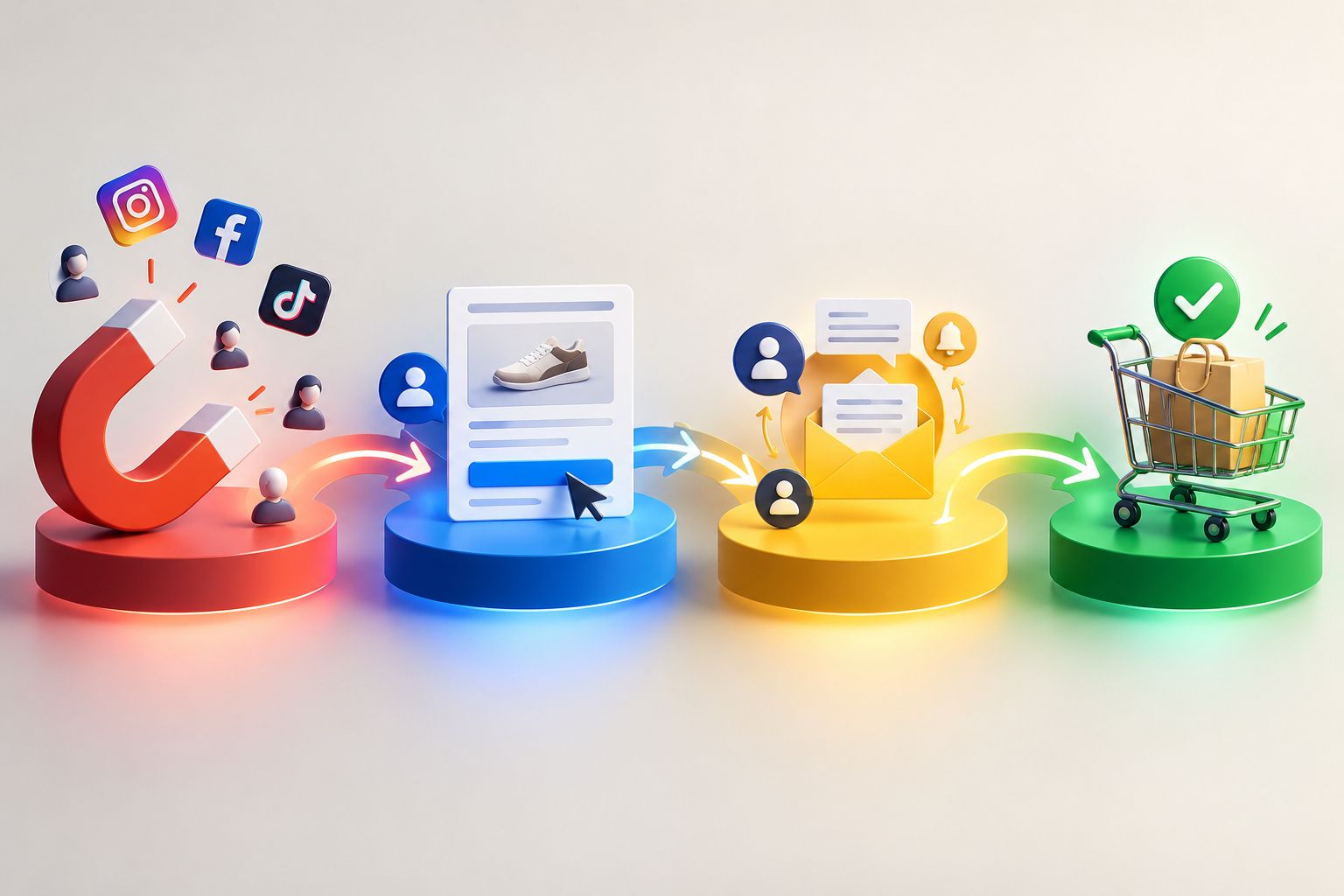
A Client Acquisition System (CAS) is the end-to-end system that every business that wants to make revenue must understand and implement. It can go by different names, from funnels to route to market, but at its core, it is the ONLY way you can make money as a business, whether you sell products or services.
There are four core pillars of a client acquisition system:
Lead Attraction
Lead Capturing
Lead Nurturing
Customer Conversion
Lead attraction: Your first task is to bring in potential customers first
Lead attraction is the first stage or sub-system in a CAS. Where you do this depends on your business' dominant platform, but it generally involves either paid traffic or organic content marketing. For best results, combine both.
Let’s take a product-based business whose dominant platform is Instagram. It can run paid Meta ads directing traffic to its website.
Lead attraction involves defining the customer avatar, targeting, budget, and the paid ads themselves.
Lead capturing: You need to stop leaking leads
This is where many businesses make their deadliest mistake. You can find mistakes elsewhere throughout the CAS, but in my experience, the mistake at this stage is often the deadliest because it kills campaigns outright.
This mistake often stems from a visibility or leakage problem, and this is why I always recommend that every business have a website. Even so, a website solves only half the problem — which is why the mistakes at this stage can be so crazy.
I’ll explain below.
Imagine your paid traffic brings in 100 people to your product’s landing page, and only 20 add items to their cart.
What happens to the remaining 80? Most businesses treat just those 20 who entered their funnel as leads, but I disagree. Every single one of them is your lead. You just had a visibility or leakage problem that prevented you from even knowing what happened on your website prior to stage visitors get to add items to cart.
This is where the double-headed lead-capture strategy comes in. The first captures those who signaled interest by adding items to cart. The second captures those who expressed interest but didn’t say it out loud. They just went through your product’s landing page and went away.
Using Meta’s technology like Pixels and CAPI, you can further retarget and bring them back into your actual bucket.
It doesn’t end there. Another mistake businesses make is assuming that the 20 that came is all there is. Nope!
You can configure your CAPI to track, let’s say, confirmed sales on your website (the highest level of interest), and use information gathered over time from all confirmed sales to run a special ad to people similar to your paying customers. So, if 20 people add items to cart, and let’s just assume they all checked out, you can find people who are similar to them when you are running ads next, so that when that ad brings in 100 people, you can get around 50 checkouts instead of 20.
YOU CAN’T DO THIS IF YOUR SALES PIPELINE moves traffic straight to a DM. It works, but it is ineffective and, in the long run, more expensive than you think.
Lead Nurturing: Not everyone will pay immediately, and you need to do something about it
Suppose 20 leads added items to cart, and only seven paid outright. What happens to the remaining 13? Most businesses do one of two things: count them as lost or forget about them.
Smart businesses follow up on them. You need to understand that not everyone will buy the first time they come across your business or enter your funnel.
This is where sales and closing systems come in. Follow up; reach out via text and calls, whichever works for you based on what they provide, or retarget them again. Yes. You can do that, but only if you set your analytics systems properly.
I have got a word-for-word copy-and-paste template I use for myself and businesses I work with. It’s not yet out, and I honestly don’t know if or when it will be, but if this sounds like what you’d like to get your hands on, send BOOKED here.
Customer Conversion: Now, you’ve made the sale
This is where the customer commits with their money. But it doesn’t end there. You need to understand that there is something called “refunds.”
You need to plan for this beforehand. Have a refund policy to protect you, and YOUR customers too.
A sale is practically useless if a customer requests a refund before the product or service gets to them. It gets much worse when the customer requests a refund after receiving the service or product. You need to find a way to ensure that they never, or rarely, ask for refunds, and when they do, you also need to find a way to handle the entire process like a standard professional.
I once asked for a refund in October 2023, and the speed at which I got it wowed me, so I stayed with the business. In another article, I will outline how to handle refunds, including how to reduce the number of refund requests you get as a business.
But for now, congratulations, you got a paying customer! Now is the time to ensure they stay, not as dormant customers, but as recurring and referring customers. Watch out for the next article on that, where I’ll explain Client Retention Systems and how it can help you make more with less.